
 Click image to view full size image


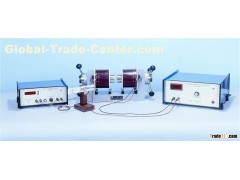
We offer Hall Effect Experiment usefull in physics and material science labs. The resistivity measurements of semiconductors cannot reveal whether one or two types of carriers are present; nor distinguish between them. However, this information can be obtained from Hall Coefficient measurements, which are also basic tools for the determination of carrier density and mobilities in conjuction with resistivity measurement.
As you are undoubtedly aware, a static magnetic field has no effect on charges unless they are in motion. When the charges flow, a magnetic field directed perpendicular to the direction of flow produces a mutually perpendicular force on the charges. When this happens, electrons and holes will be separated by opposite forces. They will in turn produce an electric field (Eh) which depends on the cross product of the magnetic intensity, H, and the current density, J.
h = RJ x H
Where R is called the Hall coefficient.
Now, let us consider a bar of semiconductor, having dimension, x, y and z. Let J is directed along X and H along Z then Eh will be along Y, as in Fig. 2.
Then we could write
Where Vh is the Hall voltage appearing between the two surfaces perpendicular to y and I = Jyz
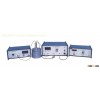
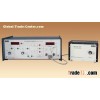
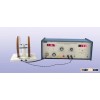
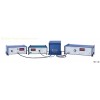
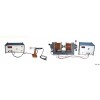
Hall Effect experiment consists of the following:
1. (a) Hall Probe (Ge Crystal);
Material: Ge single crystal n or p-type
Resistivity: 8-10 Ωcm.
Contacts: Spring type (solid silver)
Zero-field potential: <1mV (adjustable)
Hall Voltage: 35-60mV/10mA/KG
(b) Hall Probe (InAs)
Contacts: Soldered
Rated Control Current: 4mA
Zero Field Potential: <4mV
Linearity (0-20KG): ±0.5% or better
Hall Voltage: 60-70mV/4mA/KG
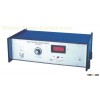
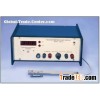
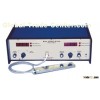
2. Hall Effect Set-up (Digital), DHE-21
DHE-21 is a high performance instrument of outstanding flexibility. The set-up consists of a digital millivoltmeter and a constant current power supply. The Hall voltage and probe current can be read on the same digital panel meter through a selector switch. It consists of the following:
(i) Digital Microvoltmeter
Range: 0-200mV (Resolutio 100μV)
Accuracy: ±0.1% of reading ±1 digit
Impedance: 1Mohm
Display: 3½ digit, 7segment LED
(ii) Constant Current Generator
Current: 0-20mA (Resolution 10μA)
Display: 3½ digit, 7segment LED
Accuracy: 0.25%; ±1 digit
Load regulation: 0.03% for 0 to full load
Line regulation: 0.05% for 10% variation
3. Electromagnet, EMU-75 or EMU-50V
4. Constant Current Power Supply, DPS-175 or DPS-50
5. Digital Gaussmeter, DGM-102
The experiment is complete in all respect.
Hall Effect Experiment